When you commission an AI system, one of the biggest concerns is whether the people building it will understand how your business actually works.
The exceptions. The information people hesitate to trust. The decisions that still need an experienced person.
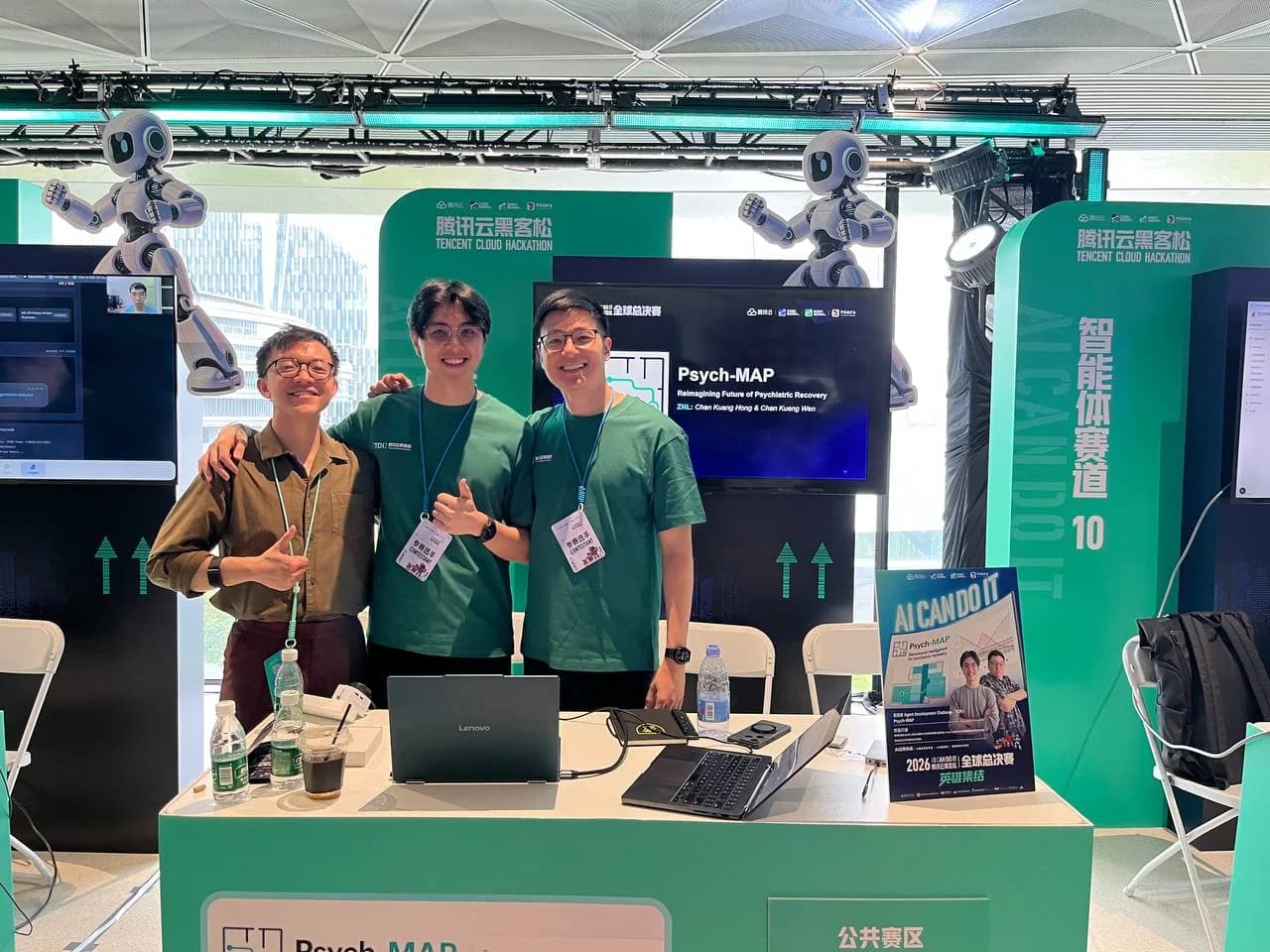
At Tencent Cloud’s global finals in Shenzhen, ZNL’s Psych-MAP showed why that understanding matters. I had followed the team from the Singapore programme. Their clinical experience was visible in what they chose to build.
The stakes shaped the system
The idea for ZNL’s Psych-MAP came from a senior occupational therapist at Singapore’s Institute of Mental Health. It grew from knowledge of the work: helping psychiatric care teams understand and review patients’ daily activity. The team demonstrated an RFID patient wristband alongside a local computing device running language models on premises.
Sensitive information, cybersecurity and professional judgment shaped the design from the start. ZNL also described choosing direct API connections over an MCP integration to simplify the architecture and reduce latency. They knew which operations the system needed.
ZNL won the Agent track championship among 41 teams and also received an additional international prize. What stayed with me was the connection between the problem, the stakes and the engineering choices.
- Sensitive informationSet the data boundaryKnow where information goes
- A few known actionsUse direct connections where they fitKeep the path easier to operate
- Failures and growing volumeSet limits and escalationMake cost and recovery predictable
That knowledge exists inside your business
For a business owner in Singapore, that is a familiar starting point. You or someone on your team knows why a report gets sent back, which exception holds up an approval and what needs checking before an answer can be trusted. That knowledge can be the starting point for a useful AI system. Bringing that person into the build helps identify which steps can follow fixed rules, which need a model and which need human approval.
Those choices affect the economics. If reporting limits the clients you can serve, reducing the bottleneck has commercial value. If an error has serious consequences, evidence and review deserve investment.
The running cost belongs in that discussion too. Ask what happens when a job retries or volume doubles. Direct connections still need retry limits and spending controls. Local models still need hardware, maintenance and someone responsible for keeping them available.
Three questions before you commission the work
Bring one real example to the conversation. Ask the builder to make these decisions concrete.
- What result would make this worthwhile?
Name the business constraint and agree how you will judge improvement.
A reporting backlog that limits the clients your team can serve.
- What must the system get right?
Identify the information boundaries, checks and approvals the work requires.
The responsible person can inspect the sources before approving a report.
- What will daily use cost?
Ask for expected usage, maintenance and what happens when work fails or volume grows.
A clear limit and escalation path when repeated attempts cannot finish a job.
Start with the problem you know.
You can bring one example of where work gets stuck. We’ll help clarify the result, the constraints and a sensible first step.
Discuss your workflow →Start with the person who knows the work
At Kairos, we work through a real example with that person, then turn the requirements into a technical design, a review process and an operating estimate.
You already have valuable expertise inside the business. A useful AI project gives that expertise a direct role in what gets built.