A challenge built around real work
Kairos worked with Tencent Cloud to bring builders together around end-to-end agents built with CodeBuddy or WorkBuddy. The brief was deliberately practical: solve a real business problem and demonstrate a system acting across the full workflow.
Kairos led the Singapore programme from challenge framing through the final showcase. It drew 175 registrations and 60 submissions, with teams moving from an idea through implementation, testing and submission.
One final night
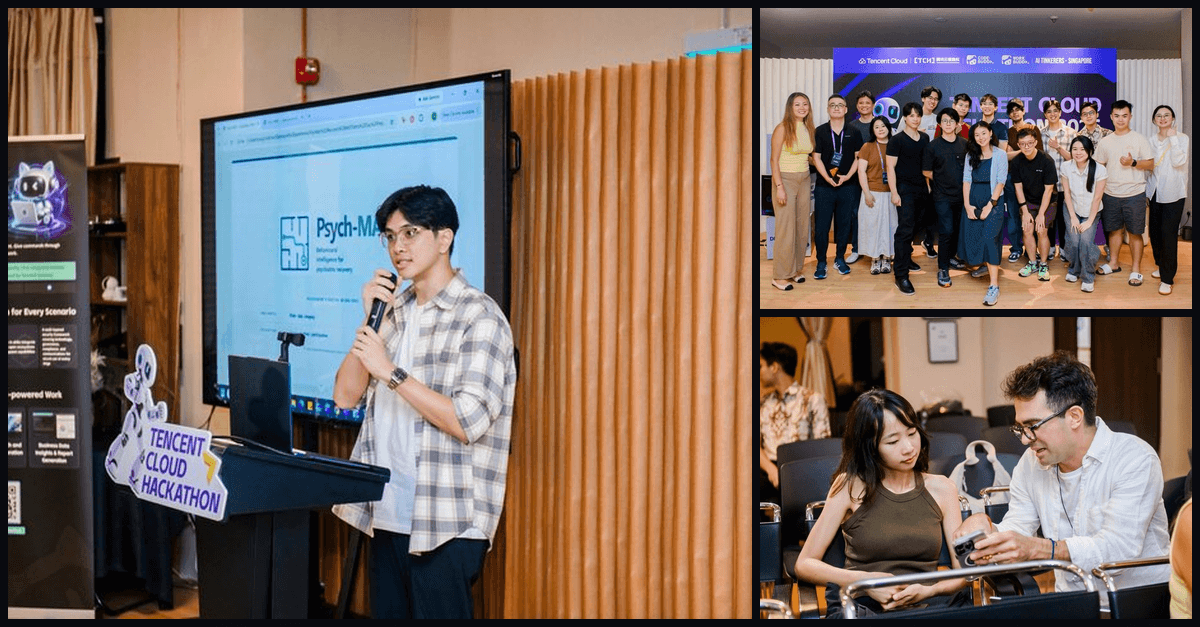
Demo Day brought the finalists into one room for live product demonstrations, direct questions, judging and a community showcase. The format kept the distance between builders and their work deliberately short: show the system, explain the decisions, and let the room test the claim.
The atmosphere was generous and exacting. The room looked past polish and asked whether each workflow held together under scrutiny.
What the winning teams showed
Continuity by Team Rocket took first place with an agent that turns a plain-language circuit-board brief into a bill of materials sourced from real parts, catches cross-component conflicts and repairs the selection before checking it again. Photo Helper by Fivecent placed second with a voice-first camera agent that translates a requested outcome into a visible, bounded plan on a real Android phone. Psych-MAP by ZNL placed third, turning scattered ward activity into deterministic measures and a visual timeline that multidisciplinary psychiatric teams can review, with AI interpretation clearly separated from diagnosis.
Their build stories were as instructive as the demos. Continuity used CodeBuddy to expose a gap between a promised interface and the data behind it before that interface was built. Photo Helper treated WorkBuddy as a review-to-verification loop, ending with 57 of 57 instrumented tests passing on a physical phone. Psych-MAP showed how a non-developer team could use CodeBuddy to turn a clinical concept into transparent metrics, profession-specific views and evidence-grounded insights for human review.
Across all three, AI sharpened planning, made constraints inspectable and produced evidence that the system worked.
What stayed with us
Agents become useful when they are attached to a real workflow, a clear outcome and a way to recover when something goes wrong. That was visible across very different projects on the night—and it is the same standard Kairos brings to production AI work.
The event was also a reminder that communities create value by making unfinished work discussable. Progress accelerated when builders could compare approaches, surface failures and leave with a more precise next step.